
23 Jul 7 Mistakes You’re Making with Google Ads Management (and How to Fix Them)
For many first-generation and minority entrepreneurs, every dollar in the marketing budget has to work double duty. You don't have the luxury of "burning" cash to find out what works. Yet, most Google Ads accounts I audit are leaking revenue through the same preventable holes.
The platform is designed to make it easy to spend money, but difficult to generate profit without a tactical approach. If you are frustrated with your Return on Ad Spend (ROAS), it’s rarely the platform’s fault. It’s almost always a management error.
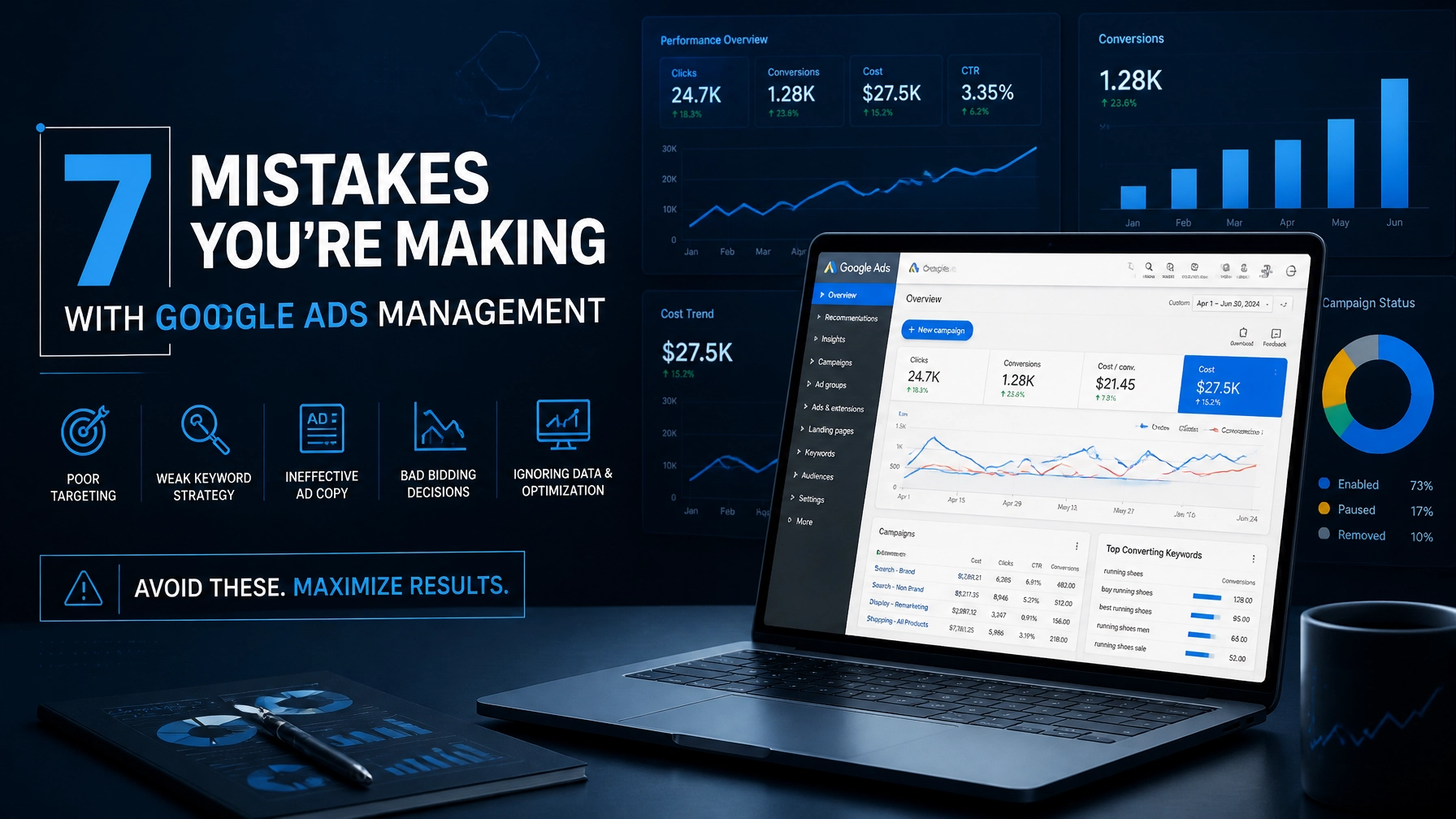
Here are the seven most common mistakes you are likely making and the exact technical steps to fix them.
1. Tracking Meaningless "Conversions"
The biggest mistake you can make is giving Google's AI the wrong goal. If you track "Homepage Visits" or "Contact Page Views" as primary conversions, you are telling the algorithm to find people who browse, not people who buy.
The Reality: Smart Bidding (Maximize Conversions, tCPA) is only as good as the data it receives. If you feed it junk data, it will optimize for junk traffic.
The Tactical Fix:
- Define Hard Conversions: Only set "Purchase," "Form Submission," or "Phone Calls > 60 seconds" as Primary conversion actions.
- Audit Your Settings: Go to Tools and Settings > Conversions. Ensure that "Page Views" are set to Secondary (Observation only).
- Use GTM: Implement Google Tag Manager to track clicks on specific buttons (like "WhatsApp" or "Get a Quote") rather than just URL loads.

2. Falling into the "Broad Match" Trap
Google heavily pushes Broad Match because it increases reach. For a small business with a tight budget, "reach" is often a synonym for "waste." If you sell "Luxury Handbags," Broad Match might show your ad for "free handbag patterns" or "handbag repair."
The Tactical Fix:
- Start Tighter: Use Phrase Match ("luxury handbags") and Exact Match ([luxury handbags]) for your core keywords.
- Gradual Expansion: Only move to Broad Match once you have a stable stream of 30+ conversions per month and are using a Value-Based Bidding strategy.
- Check Your Match Types: If your CPC is high but your conversion rate is low, audit your keyword list immediately and switch "Broad" to "Phrase."
3. Ignoring Negative Keywords
You are likely paying for clicks from people who have no intention of buying from you. If you don't have a robust negative keyword list, you are subsidizing Google’s revenue at the expense of your own.
Pro-Tip for Minority Business Owners: If you offer high-end services, ensure you are excluding "cheap," "free," or "discount" to preserve your margins.
The Tactical Fix:
- Review Search Terms Daily: Go to the Keywords > Search Terms report. Any term that is irrelevant to your business should be added as a Negative Keyword.
- Build a Master List: Create a "Junk" list in your Shared Library that includes universal negatives: free, job, hiring, internship, cheap, torrent, diy.
- Filter the Noise: Use the funnel approach: filter out the low-intent traffic so your budget only hits the high-value targets.

4. Poor Account and Ad Group Structure
I often see "The Jumble." This is one campaign with one ad group containing 50 different keywords and two generic ads. When you do this, your ad copy can't possibly be relevant to every search term. This kills your Quality Score and raises your costs.
The Tactical Fix:
- Themed Ad Groups: Limit each ad group to 5–10 closely related keywords.
- Mirror the Search: If the keyword is "Business SEO Services," the headline of the ad should say "Business SEO Services."
- Internal Link Strategy: Understand the difference between SEO and Google Ads and structure your campaigns to complement your organic efforts.
5. Sending Paid Traffic to Your Homepage
This is the fastest way to lose a lead. A user clicks your ad because they want a specific solution. If they land on your homepage, they have to work to find that solution. Most won't.
The Tactical Fix:
- Dedicated Landing Pages: Every campaign should point to a specific page that addresses the ad's promise.
- One Clear CTA: Your landing page should have one goal: get the lead. Remove the main navigation menu if it's distracting users from the contact form.
- Mobile-First Design: 70%+ of your clicks will likely come from mobile. If your page takes more than 3 seconds to load or has tiny buttons, you are losing money.
6. Blind Trust in Google’s "Recommendations"
The "Recommendations" tab is not always your friend. Google’s goal is to increase platform spend. Your goal is to increase profit. These are not always aligned.
Common "Bad" Advice: "Add Broad Match keywords" or "Increase your budget by 50%."
The Tactical Fix:
- Disable Auto-Apply: Go to the Recommendations tab, click Auto-apply in the top right, and uncheck everything.
- Manual Review Only: Only apply recommendations that improve your ad strength (like adding sitelinks) or fix broken settings. Ignore anything that asks you to broaden your targeting or spend more without data to back it up.

7. The "Set and Forget" Mentality
Google Ads is not a slow cooker. You cannot "set it and forget it." Market conditions change, competitors enter the auction, and search trends shift.
The Tactical Fix:
- Weekly Audit Cadence:
- Monday: Review Search Terms and add negatives.
- Wednesday: Check budget pacing.
- Friday: A/B test one ad headline or description.
- Watch the Data: Use real-time analytics to see which keywords are actually driving revenue, not just clicks.
- Scale Winners, Kill Losers: If a keyword has spent 2x your target CPA without a conversion, pause it. Don't "hope" it will get better.

The Bottom Line
Google Ads is a technical tool that requires a technical operator. For minority-owned businesses and startups, efficiency is the only path to scale. By fixing these seven errors, you stop the bleeding and start building a predictable lead generation machine.
If managing this level of detail feels like a full-time job, it’s because it is. At URBN Agency, we specialize in taking this burden off your plate with a unified platform and a data-first approach.
Ready to stop wasting your ad budget? Contact us today for a comprehensive audit of your Google Ads account.
Sorry, the comment form is closed at this time.