
23 Jul AI Search Matters: Why You Need to Rethink Your SEO Services Now
The traditional SEO model is dying. If your current agency is still reporting on "blue link" rankings and keyword volume as their primary KPIs, you are losing ground to a new reality: the Answer Engine.
Between Google’s AI Overviews (SGE), Perplexity, and ChatGPT, the way users find information has fundamentally shifted. We are no longer in an era of "Search Engine Optimization." We are in the era of Generative Engine Optimization (GEO).
By the end of 2024, zero-click searches: where the user gets their answer directly on the results page without clicking a link: climbed to roughly 60%. When an AI Overview appears, the click-through rate (CTR) for the top organic result drops by as much as 35%.
This is not a "trend." It is a structural overhaul of the internet. Here is why you need to rethink your SEO services and how to adapt your strategy for the AI-first world.
1. From Keywords to Entities
Traditional SEO was built on the back of keywords. You found a high-volume phrase, sprinkled it into your H1s and meta tags, and hoped for the best.
AI search engines don't look for keywords; they look for entities. An entity is a well-defined person, place, thing, or concept. Google’s Knowledge Graph and LLMs (Large Language Models) like Perplexity categorize your business as an entity with specific attributes.
The Tactical Shift
Stop optimizing for "best digital marketing agency." Start optimizing for your brand’s authority within the "Digital Marketing" entity. This requires:
- Consistent NAP (Name, Address, Phone): Crucial for local entities.
- Organization Schema: Telling the AI exactly who you are and what you do in a language it speaks (JSON-LD).
- Contextual Backlinks: Links from other established entities in your niche, rather than low-quality guest posts.

2. The Rise of Factual Density
AI engines prioritize "summarizability." If your content is 2,000 words of fluff designed to hit a word count, an AI will ignore it. It can't extract a clean answer from a wall of marketing jargon.
To win in AI search, your content must have high factual density. This means providing clear, data-backed answers early in your content.
Implementation Guide:
- Front-load the Answer: Use the "inverted pyramid" style. Give the direct answer in the first paragraph.
- Use Structured Formats: AI loves tables, bullet points, and numbered lists. They are easy to parse and cite.
- Cite Original Data: AI models like Perplexity favor sources that provide original research or expert commentary. If you are just rehashing what everyone else is saying, you have no "information gain" value.
At URBN Agency, we move beyond simple content creation. Our unified platform integrates machine learning to identify the exact data points AI engines are looking for in your specific industry.
3. E-E-A-T is No Longer Optional
Experience, Expertise, Authoritativeness, and Trustworthiness (E-E-A-T) used to be a "best practice." Now, it is a survival requirement. AI search engines are programmed to avoid "hallucinations" by citing sources they perceive as safe and expert-led.
If your blog posts don't have a clear author byline, a link to a professional bio, and citations to reputable sources, an AI engine will rarely choose you as a cited source in an answer.

Actionable Takeaway:
Review your existing content. Are you leveraging real human expertise? AI can write a generic guide on "how to save money on ads," but it can't replicate the specific insights found in our guide on SEO vs. Google Ads for small business growth. That specific, experience-driven insight is what gets cited in AI Overviews.
4. The "Zero-Click" Measurement Crisis
If your SEO agency is still sending you reports that focus solely on "Organic Sessions," they are missing half the picture.
In the AI era, success looks different:
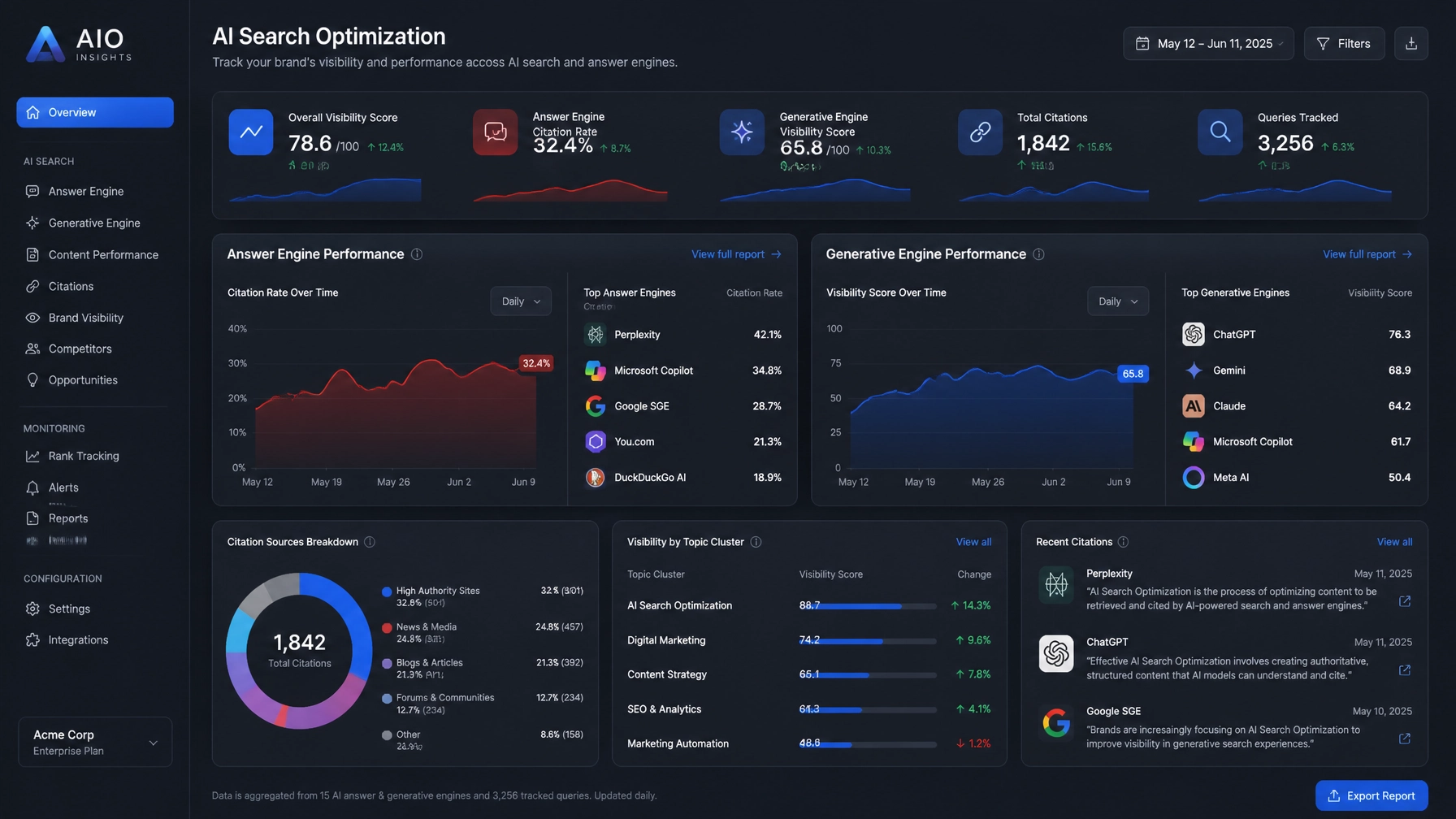
- Brand Mentions in AI Answers: Is ChatGPT or Perplexity recommending your brand when asked for a solution?
- Citation Share: How often is your website linked as a source in a Google AI Overview?
- Conversion Quality: While total traffic may decrease, the traffic that does click through from an AI answer is often much further down the funnel and ready to buy.

You must adapt your tracking to reflect these new realities. We use automated reporting and real-time analytics to track not just where you rank, but how your brand is being "perceived" by the algorithms driving today’s search.
5. Technical SEO: Beyond Speed
Yes, site speed matters. If you are optimizing WordPress, you already know that performance is a baseline requirement. But technical SEO for AI also includes API-readiness.
Is your content easy for a crawler to "read" and "understand" instantly?
- Schema Markup: You need more than just "Article" schema. Use FAQ, Product, Review, and HowTo schema to give the AI structured data it can use to build its answers.
- Clear Information Architecture: A messy site structure confuses LLMs. Use a logical hierarchy that reinforces your topical authority.
Why "Unified" Marketing is the Only Way Forward
The silos of "SEO," "Paid Search," and "Social Media" are dissolving. AI engines pull data from everywhere: your website, your Facebook Ads, your reviews, and even your social mentions.
If your SEO isn't talking to your Paid Ads team, you're leaving money on the table. For example, high-performing ad copy can often signal to an SEO team what "intent" is currently converting, allowing for faster content pivots.

At URBN Agency, we provide all these services under one roof. We don't just "do SEO." We build a digital ecosystem where every touchpoint: from a Google Ads campaign to a technical blog post: feeds into a single goal: making your brand the undisputed authority in your space.
Your AI Search Checklist
If you want to stay relevant in 2025 and beyond, execute these steps immediately:
- Audit for AI Visibility: Search for your top 10 "problem" keywords in Perplexity and Google. Is your brand cited? If not, identify which competitors are and analyze their content structure.
- Add Expert Quotes: Interview your internal subject matter experts and add their direct quotes to your top-performing pages.
- Upgrade Your Schema: Ensure every product, service, and major blog post has detailed JSON-LD schema.
- Prune Low-Value Content: If a page doesn't provide a clear, factual answer or unique value, it’s dragging your site’s authority down. Delete it or consolidate it.
- Focus on Intent: Stop chasing high-volume, top-of-funnel keywords that AI will simply summarize. Focus on middle-and-bottom-of-funnel queries where the user needs your specific expertise to make a decision.
The landscape has changed. Your SEO services must change with it. If you’re ready to move beyond basic rankings and start dominating the answer engines, contact us today.
Sorry, the comment form is closed at this time.